
Tickets in. Reviewed pull requests out.
OpenFactory takes a card from your board, runs a coding agent on it in a sandbox with your project's own test gates, has a second agent review the result, and opens the pull request. You decide what gets built and what ships.
curl -fsSL https://openfactory.digital/install.sh | sh
# pulls the published images and starts the panel
# on http://localhost:8787
One assistant per developer does not scale. A pipeline does.
Claude Code, Codex and Kimi make one person faster. They are licensed per seat and driven by hand: someone starts each task, stays with it, and carries it to a pull request. Capacity is still headcount.
OpenFactory runs those same agents as a pipeline the team owns. Tickets go in without a person attached to each one, and the number you manage becomes cost per merged ticket instead of seats per month. People keep the decisions that need judgment and stop being the hand-off between a ticket and a PR.
Same agents on both sides. The difference is whether a person has to drive each one.
Works with the tools you already run
OpenFactory sits between your tracker and your coding agent. Each provider is a registry entry, so you can swap the tracker, the forge, the CI observer or the agent independently.
The tech-lead classifies the failure
It parks the ticket, works out what would fix it, retries only what is safe to retry, and escalates the rest to a person as a concrete question. Where the boundary is.
The product role scopes the work
Talks to the requester, reads the board, and proposes tickets with the requirement behind each one. Nothing enters the queue until a person accepts it. The roles.
Fewer tokens per ticket. Same wall-clock.
OpenFactory keeps a module map of your codebase and puts it in the agent's context, so the agent reads less to find the same code. A/B on one production codebase, n = 8 tickets per arm, medians, scanned 2026-09-01:
Wall-clock did not move. The map makes a ticket cheaper, not faster.
Eight tickets per arm on one codebase is a signal, not proof. The arm definitions, the method and what is excluded are in docs/knowledge-layer.md. The platform reports the deltas and leaves the verdict to you: it cannot know whether the two ticket mixes are comparable.
See it run
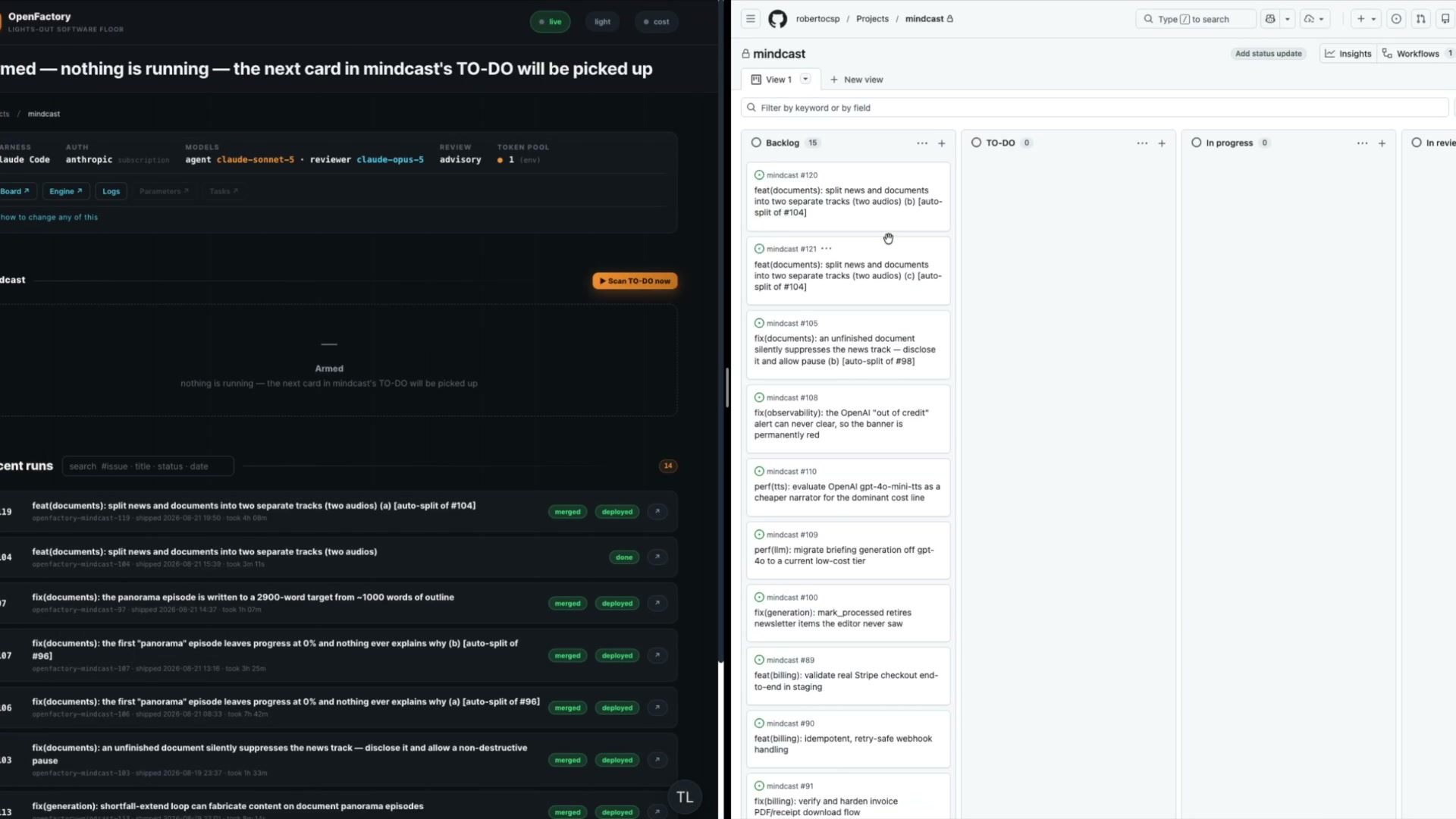
One ticket going through: sized, built in a sandbox, gated, opened as a PR, reviewed by a second agent, and reported back on the card.
What you keep. What it takes.
You keep the decisions
Policy approves the routine steps, so nobody signs off on test runs. What gets built, whether it merges, and every promotion to production stay with a person.
It never fails silently
An unreadable board is not an empty queue. A stalled job retries within its budget or puts a concrete question on the card. The test suite treats going quiet as a bug.
Your machines, your gates, your fork
docker compose up, no cloud account. It runs your project's own build
and test commands. Apache-2.0: read it, fork it, add a provider with one module and
one registry row.
Known limits are written down. Read them before you adopt it →
Docker is the only prerequisite
No Python on the host, no sudo. The script pulls the published images,
asks only what it cannot infer from the machine, and leaves the panel at
http://localhost:8787.
curl -fsSL https://openfactory.digital/install.sh | sh
| read it first | curl -fsSL https://openfactory.digital/install.sh -o install.sh && less install.sh && sh install.sh |
| by hand | the commands are in the README, pinned to a release and verified against its checksums |
The worker mounts the host's Docker socket to start sandbox containers. That is root-equivalent on the host, the same trade any compose stack that mounts the socket makes.
The installer sends nothing anywhere. There is no phone-home telemetry.
Re-run the installer to upgrade. It pulls the newest release and restarts the stack. Your configuration and data survive.
docker compose --env-file .env.compose exec worker openfactory project init myapp https://github.com/<owner>/myapp.git
That registers the project, creates the board with the platform's columns, and
scaffolds .openfactory/project.yaml.
openfactory doctor myapp then lists what is still missing, with a remedy
for each item, including the two credentials it cannot infer: the coding agent's and a
forge token.
Read the code. Run it on your own machines.
Apache-2.0. No cloud account, no telemetry.